
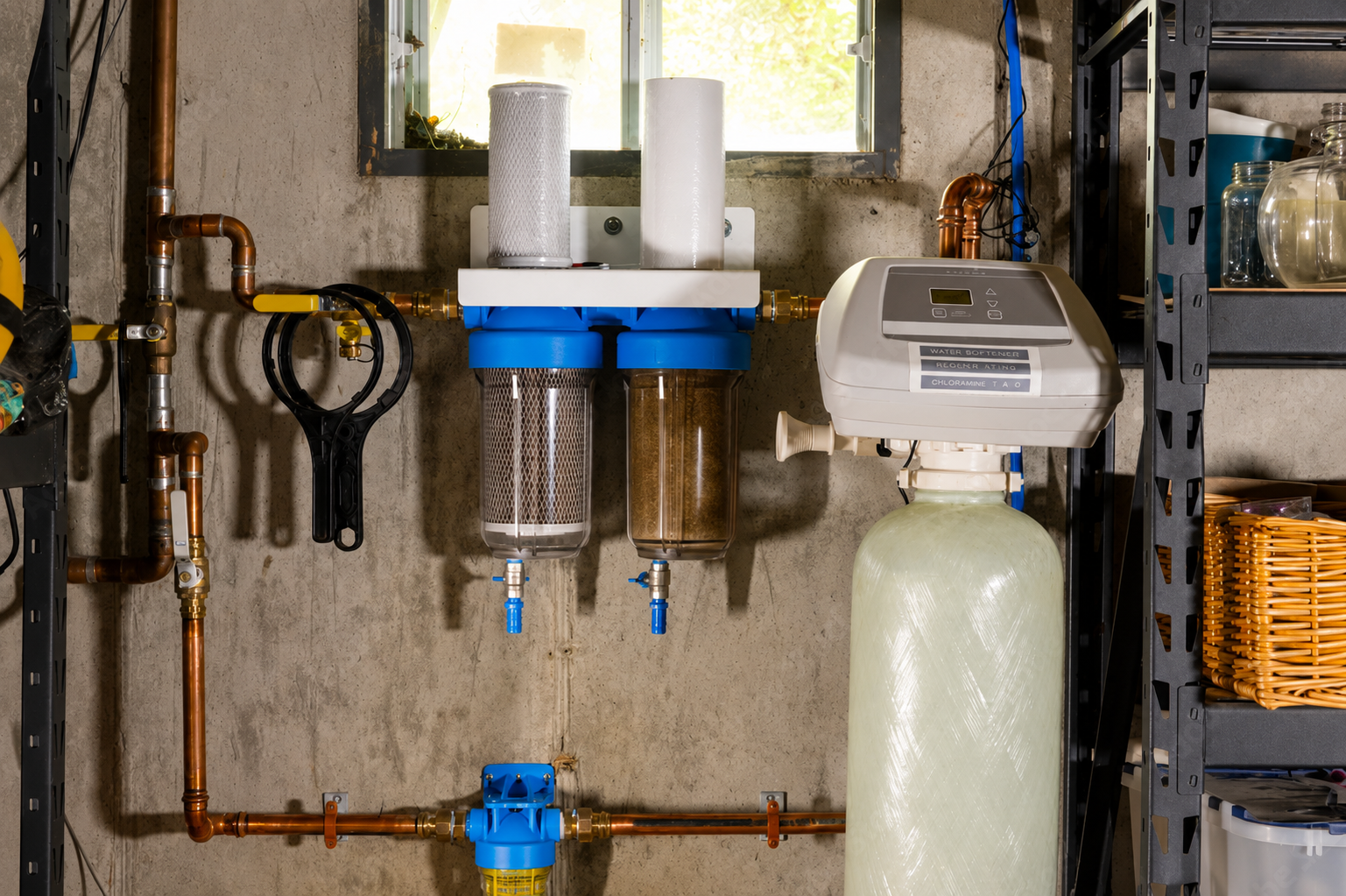
Home water filtration systems can solve different water problems, but they do not all solve the same problem. That is where many homeowners get stuck.
One filter may improve the chlorine taste. Another may reduce sediment. A reverse osmosis system may treat drinking water at one faucet. A water softener may handle hardness, but it is not the same thing as a standard filter.
In Indianapolis, the right choice depends on your home, plumbing, water source, and water test results. Guessing can waste money. Testing gives you a better place to start.
Water affects more than taste. It can affect showers, laundry, dishwashers, water heaters, ice makers, coffee makers, fixtures, and plumbing. If your home has hard water, sediment, chlorine odor, or cloudy water, the right treatment system can make daily water use easier and help protect the equipment connected to your plumbing.
There are many options, including faucet water filters, whole-home water filtration systems, reverse osmosis filters, activated carbon filters, ion exchange filters, mechanical filters, ultraviolet filters, and distillation filters. They all sound useful, but each one has a different job.
That’s why the best first step is not buying a filter online; it’s understanding what is actually in your water.
How Does a Water Filtration System Work?
A water filtration system works by moving water through one or more treatment stages. Each stage targets specific issues.
Some filters use carbon. Some use screens or cartridges. Others use membranes, UV light, or ion exchange resin. EPA guidance lists several treatment technologies used for drinking water, including activated carbon, ion exchange, reverse osmosis, and ultraviolet treatment.
So, how does water filtration work in plain terms? Water passes through a material, membrane, or treatment device that reduces certain contaminants before the water reaches your faucet, appliance, or whole home.
The keyword is “certain.” No single filter fixes everything.
A filter that improves taste may not reduce hardness. A water softener that reduces scale may not remove the chlorine taste. A reverse osmosis system that treats drinking water may not treat the water going to your shower, dishwasher, or washing machine.
That is why water testing matters. Your system should match the water problem, not a guess based on taste or smell.
A local water treatment company can help identify whether your concern is hardness, chlorine, sediment, iron, total dissolved solids, odor, or another issue. From there, you can choose a system that fits your home, plumbing, and daily usage.
Why Indianapolis Water Problems Vary by Home
Two Indianapolis homes can have different water concerns, even if they sit a few miles apart.
One home may have old plumbing. Another may have newer lines but a more visible scale. A private well has different testing needs than a home on public water. Even homes on the same system can notice different tastes, odors, or staining due to plumbing, fixtures, water heater condition, and daily use.
Hardness is one major local issue. Citizens Energy Group’s 2025 Indianapolis and Morgan County water data lists average hardness at 317 ppm, or 19 grains per gallon. That is hard water by any practical homeowner standard.
Hard water does not always look dirty. In many cases, it looks clear. The issue is what the water leaves behind. Calcium and magnesium minerals can create scale on faucets, showerheads, glass doors, dishes, plumbing connections, and appliances.
Chlorine taste or odor can also show up. Citizens reports chloramines, measured as total chlorine, are used in the Indianapolis system to control microbes, with 2025 data showing regulatory compliance.
That does not mean the water is unsafe. It means some homeowners may notice taste or odor and want a carbon filtration solution for better drinking, cooking, and bathing comfort.
A local test helps sort out what is actually happening at your tap. It also helps avoid the common mistake of buying one product and expecting it to solve every water concern.
Common Signs You May Need Water Filtration

Your water may give you clues before you test it.
Common signs include:
- Cloudy water
- Chlorine taste or smell
- Rust-colored staining
- Sediment in sinks or tubs
- Scale on faucets and showerheads
- Dry-feeling hair or skin after bathing
- Spots on dishes and glassware
- Shorter appliance life
- Buildup around fixtures
These symptoms can point to different issues. Scale usually points toward hardness. The chlorine taste may point toward disinfectant taste and odor. Rust-colored staining may relate to iron or plumbing. Gritty particles may point toward sediment.
It is also common for homeowners to notice more than one issue at the same time. For example, you might have hard water scale on shower doors and a chlorine taste in drinking water. Those two concerns may require two different treatment methods.
That is why whole home water filtration systems are often designed around multiple stages. A home may need sediment filtration first, then activated carbon filtration, and then a water softener. Another home may need a reverse osmosis drinking water system at the kitchen sink, plus a separate softener for hardness.
Do not buy based on one symptom alone. Test first, then choose.
What Do Home Water Filtration Systems Filter?
Home water filtration systems can reduce many water concerns, depending on the system.
Carbon filters may help reduce chlorine taste, odor, and some organic compounds. Reverse osmosis filters use a membrane to reduce a wider range of dissolved substances at a drinking water tap. Ion exchange filters use charged resin to attract and hold certain dissolved materials. UV systems use ultraviolet light as a treatment step for microbes, often with pre-filtration.
Some systems focus on the whole home. Others focus on one faucet.
Faucet water filters may help with the taste of drinking water. But they do not treat water going to your shower, dishwasher, laundry, or water heater.
Whole home filtration systems treat water near the point it enters the home. That can help protect more fixtures, depending on the system design.
A whole-house system may be a better fit when the issue affects multiple rooms or appliances. For example, if you notice a chlorine odor in showers, sediment in tubs, or buildup around fixtures throughout the home, a small drinking water filter will not address the full problem.
If the goal is better-tasting drinking water, reverse osmosis or carbon filtration may help. If the goal is a smaller scale, a water softener may be needed. If the goal is to reduce sediment, a mechanical filter may be the right first step.
Types of Water Filtration Systems
There are several types of water filtration systems. Each has a specific job.
Some homes need one system. Others need a combination, such as a sediment filter, carbon filter, water softener, and reverse osmosis drinking water system.
Product names can sound similar, but the technology inside the system matters more than the label on the box. A “whole-house filter” may use carbon, sediment filtration, specialty media, or a combination of stages. A “drinking water filter” may be a simple cartridge or a more advanced reverse osmosis system.
When comparing the types of water filtration systems, look at what each system is designed to reduce, how often it needs service, where it is installed, and whether it treats one faucet or the entire home.
Whole-House Water Filtration Systems
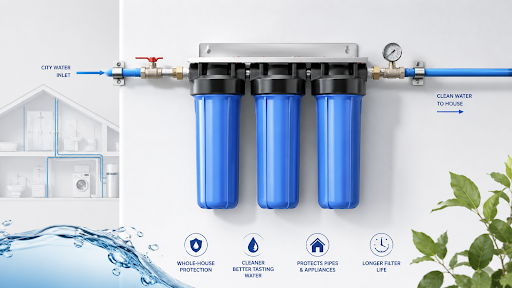
Whole-house water filtration systems treat water before it moves through most of your plumbing.
These systems can help with sediment, chlorine taste and odor, and certain water concerns, depending on the filter media used. They are often a good fit when the issue affects showers, laundry, fixtures, or appliances.
Whole home water filtration systems are not always the same as water softeners. If your main issue is hardness, you may need a softener. If your main issue is taste or odor, you may need filtration. Some homes need both.
A whole-house system is usually installed near the main water line where water enters the home. This allows treated water to reach multiple fixtures instead of only one sink.
For Indianapolis homeowners, this can be useful when water concerns show up throughout the house. If every bathroom has scale, every shower has a chlorine smell, or every fixture has buildup, a whole-home approach may be more practical than adding small filters one by one.
Activated Carbon Filters
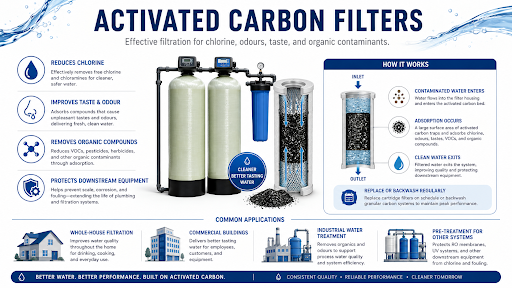
Activated carbon filters are common because they can help improve taste and odor.
They are often used for chlorine-related taste, smell, and certain organic compounds. The EPA describes granular activated carbon as a treatment method used in drinking water systems.
Carbon filters can be used in whole-home systems, under-sink systems, and faucet water filters.
They need a replacement on schedule. An old carbon filter can lose performance and become a maintenance problem.
Activated carbon filters do not solve every issue. They do not remove hardness minerals like calcium and magnesium. They are also not a substitute for a water softener when scale is the main problem.
That is why carbon filtration is often paired with other systems. In some homes, carbon improves taste and odor while a softener handles hardness. In other homes, carbon may be used before reverse osmosis filters to help protect the membrane and improve drinking water quality.
Ion Exchange Filters
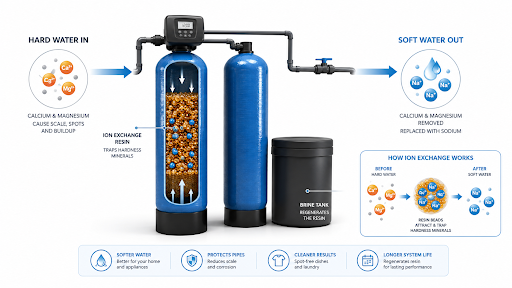
Ion exchange filters use resin beads to exchange ions in the water.
Water softeners use ion exchange to reduce hardness minerals like calcium and magnesium. That matters in Indianapolis because hard water can leave scale on fixtures, water heaters, dishwashers, and plumbing.
Ion exchange can also be used in other treatment settings, depending on the target contaminant. EPA includes ion exchange among drinking water treatment technologies.
Superior Water Treatment uses high-efficiency Clack valve systems and 10% crosslinked resin in its softeners. That resin has 25% more crosslinking than standard 8% resin, which prolongs service life compared to standard softeners.
Ion exchange filters are best known for softening because they target the minerals that cause scale. In a softener, calcium and magnesium are exchanged for sodium or potassium ions, depending on the system and settings.
For Indianapolis homeowners, a water softener can be one of the most practical parts of a whole-home water treatment plan. It does not replace every filter, but it can help address one of the area’s most common water problems.
Reverse Osmosis Water Filtration Systems
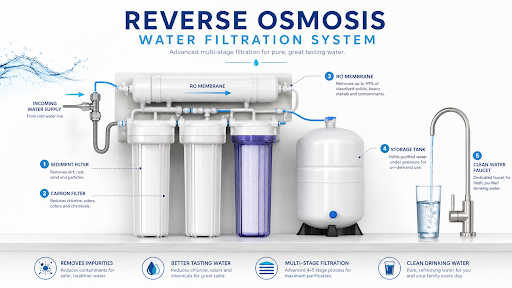
Reverse osmosis water filtration systems push water through a semi-permeable membrane. That membrane helps reduce many dissolved substances in drinking water.
Reverse osmosis filters are often installed under the kitchen sink for drinking and cooking water. They can be a good fit when taste, dissolved solids, or certain contaminant concerns show up in testing.
EPA notes that reverse osmosis systems use a thin barrier to separate chemicals from water, creating treated water and a waste stream.
These systems need filter and membrane changes. They also need proper installation.
Reverse osmosis is often chosen by homeowners who want a dedicated drinking water system. It can improve the water used for coffee, tea, ice, cooking, and drinking.
However, reverse osmosis is usually a point-of-use system, not a whole-home system. That means it treats water at one location, usually the kitchen sink. It does not soften water throughout the home or treat water going to showers, laundry, or the water heater.
Mechanical Filters
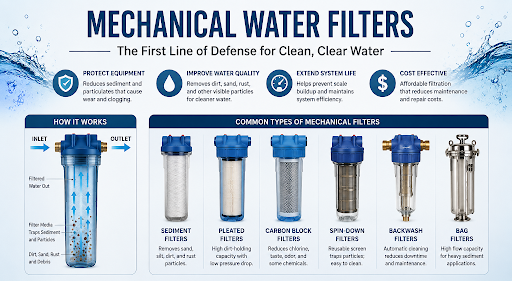
Mechanical filters strain particles from water.
They may reduce sediment, sand, rust particles, and other visible debris. They are often used before other equipment to help protect the rest of the system.
A mechanical filter does not usually solve taste, odor, hardness, or dissolved contaminant concerns by itself.
Think of it as the first line of defense when particles are the issue.
Mechanical filters are often rated by micron size. A smaller micron rating can capture smaller particles, but it may also restrict flow more quickly if the water has heavy sediment. That is why the right filter size and replacement schedule matter.
These filters are commonly used in homes with visible particles, older plumbing, well water, or sediment concerns. They may also be installed before carbon filters, softeners, UV systems, or reverse osmosis filters.
Ultraviolet Filters
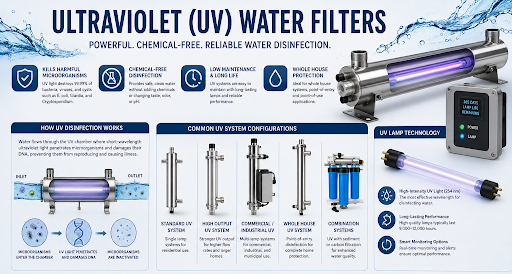
Ultraviolet filters use UV light as a treatment step.
They are often used when microbial control is a concern, especially with well water. EPA lists UV treatment as a drinking water treatment technology, and CDC guidance notes that UV systems work better when water is filtered before the UV step.
UV does not remove sediment, chlorine taste, hardness, or dissolved minerals. It is usually part of a larger system.
Distillation filters are another option for some drinking water needs, but they are less common for whole-home use because they treat water slowly and are usually point-of-use systems.
UV systems need clear water to work properly. If water has sediment or cloudiness, the UV light may not reach the target effectively. That is why pre-filtration is often recommended before UV treatment.
Considerations When Choosing a Whole Home Filter
Start with a water test.
Then look at:
- Your main concern
- Public water or well water
- Water hardness level
- Plumbing age
- Flow rate needs
- Number of bathrooms
- Filter replacement schedule
- Available space
- Long-term service cost
What are the best water filtration systems? The best system is the one matched to your actual water test and daily use.
For an Indianapolis home, that may mean a carbon filter, sediment filter, reverse osmosis drinking water system, water softener, or combined setup.
Flow rate is one of the greatest details to review. A filter that is too small may reduce water pressure when multiple fixtures run at the same time. That can be frustrating in larger homes, homes with multiple bathrooms, or households with high daily water use.
Maintenance is another key factor. Every system needs service at some point. Filters need replacement. Salt may need delivery for softeners. Reverse osmosis membranes need scheduled changes. UV lamps need replacement.
Cost should also be viewed beyond the first purchase. A cheaper system may cost more over time if it needs frequent replacement, causes pressure issues, or fails to solve the actual water problem.
A local water treatment company can help you avoid buying the wrong equipment.
FAQs about Home Water Filtration Systems
Water filtration can get confusing because many systems sound similar but solve different problems. A whole-house filter, reverse osmosis system, faucet filter, UV system, and water softener can all be useful, but the right choice depends on what is actually in your water.
What is the Best Home Water Filtration System?
The best home water filtration system is the one matched to your actual water issue. For many Indianapolis homes, that may mean a whole-house carbon filter, sediment filter, reverse osmosis system, water softener, or a combination of systems. A water test is the best first step because different filters target different concerns, and no single filter solves everything. EPA guidance confirms that treatment technologies vary by contaminant type, including activated carbon, ion exchange, reverse osmosis, and UV-based systems.
How Does a Water Filtration System Work?
A water filtration system works by moving water through filter media, a membrane, and a treatment stage that reduces specific contaminants. Activated carbon can help with taste, odor, and certain organic compounds, while reverse osmosis uses a semi-permeable membrane to reduce a wider range of dissolved substances. The right setup depends on what is in the water.
Does a Whole-House Water Filter Remove Hard Water?
No, a standard whole-house water filter does not usually remove hard water. Hard water is caused mainly by minerals like calcium and magnesium, which are typically handled by a water softener or ion exchange system. In Indianapolis, hardness is a major local concern: Citizens Energy Group’s 2025 data lists average hardness at 317 ppm / 19 grains per gallon.
Why Does My Indianapolis Water Taste or Smell Like Chlorine?
Your water may taste or smell like chlorine because disinfectants are used to control microbes in public water systems. In the Indianapolis distribution system, Citizens Energy Group reports chloramines measured as total chlorine, with 2025 system data showing compliance with regulatory limits. A properly selected carbon filtration system can often improve chlorine-related taste and odor.
What Does a Whole-House Water Filter Remove?
A whole-house water filter can reduce sediment, chlorine taste and odor, rust particles, and certain contaminants depending on the filter type. Carbon filters, sediment filters, specialty media, UV systems, and reverse osmosis all do different jobs. That’s why the system should be selected based on water testing instead of symptoms alone.
When to Call a Local Indianapolis Water Treatment Professional
Call a local professional when the problem affects more than one fixture, keeps coming back, or could affect appliances.
That includes hard water scale, chlorine taste, sediment, staining, water heater buildup, or poor drinking water taste.
You should also call a professional if you are unsure whether you need a filter, water softener, reverse osmosis system, or a combined setup. Buying the wrong equipment can lead to wasted money and continued water problems.
A local expert can test your water, review your plumbing, check your water usage, and recommend the right system size. This matters because water treatment is not only about choosing the right technology. It is also about proper installation, flow rate, maintenance, and long-term performance.
Superior Water Treatment helps homeowners choose practical water treatment based on local conditions. Their systems are built with premium components, including high-efficiency Clack valve systems and 10% crosslinked resin in their water softeners. That resin has 25% more crosslinking than standard 8% resin, providing better durability than other standard softeners.
Home water filtration systems work best when they match the real issue in your water. In Indianapolis, that often means looking at hardness, chlorine taste, sediment, plumbing conditions, and drinking water goals together.
Contact Superior Water to schedule a water check, review your options, and ask about our water treatment services.